
Hy MAI: An ethno-STEM-based interactive website to improve high school students’ reasoning skills
##plugins.themes.bootstrap3.article.sidebar##
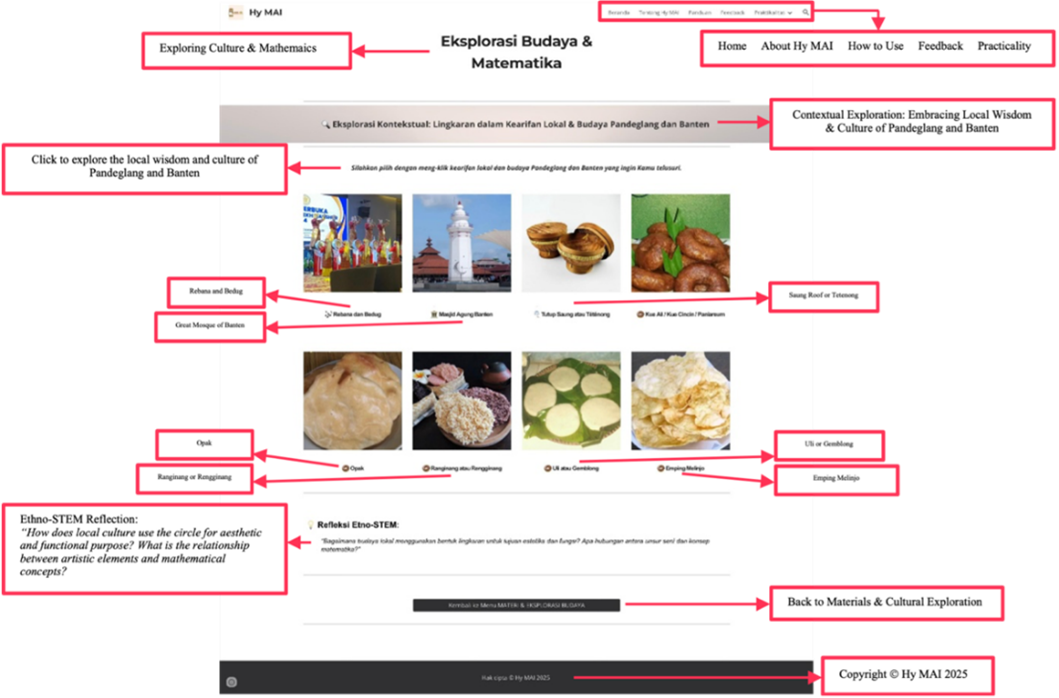
##plugins.themes.bootstrap3.article.main##
Abstract
Prior studies on students' mathematical reasoning abilities have shown that multimodal representations and local culture can bridge the gap between abstract concepts and students' understanding. To address this gap, this study developed and evaluated the interactive website Hy MAI, grounded in the Ethno-STEM approach, as a pedagogical innovation and theoretical contribution to design-based mathematics education. This study used Research and Development methods within an educational design research framework. Participants included expert validators (n = 4), one mathematics teacher, and eleventh-grade students (n = 74; 37 experimental, 37 control). Data were collected through expert validation sheets, teacher and student questionnaires, and pre- and post-tests. Expert validation yielded an average score of 3.40 (Good), confirming the accuracy of the content, interactivity, and cultural integration. Teachers rated practicality at 4.00 (Very Good), while students rated it at 3.03 (Practical). Effectiveness analysis showed significant improvements in reasoning skills. A paired-sample t-test yielded t(36) = –19.60, p < 0.001, and an independent-sample t-test revealed a significant post-test difference, t(72) = 8.77, p < 0.001. The N-Gain analysis showed 62.35% for the experimental group versus 16.08% for the control group. Overall, Hy MAI proved valid, practical, and effective, while also making theoretical contributions by demonstrating the systematic integration of technology, STEM principles, and local culture in mathematics education.
##plugins.themes.bootstrap3.article.details##

This work is licensed under a Creative Commons Attribution-ShareAlike 4.0 International License.
The author is responsible for acquiring the permission(s) to reproduce any copyrighted figures, tables, data, or text that are being used in the submitted paper. Authors should note that text quotations of more than 250 words from a published or copyrighted work will require grant of permission from the original publisher to reprint. The written permission letter(s) must be submitted together with the manuscript.References
Akbarini, N. R. (2024). Using technology acceptance model (TAM) to explain teachers' adoption of digital technology in business education. Jurnal Pendidikan dan Pengajaran, 57(2), 309–321. https://doi.org/10.23887/jpp.v57i2.74301
Akker, J. V. d., Bannan, B., Kelly, A. E., Nieveen, N., & Plomp, T. (2013). Educational design research part A: An introduction. Enschede, Netherlands: SLO.
Akker, J. V. d., Gravemeijer, K., McKenney, S., & Nieveen, N. (2006). Educational design research. Routledge. https://doi.org/10.4324/9780203088364
Anwar, R., Rahmawati, D., & Wulandari, A. (2025). Trends in research on mathematical representation in mathematics learning: A systematic literature review. International Journal of Education in Mathematics, Science and Technology, 13(3), 698–714. https://doi.org/10.46328/ijemst.4848
Asyura, I., & Dewi, R. (2020). Analisis kemampuan matematis mahasiswa PGSD terhadap penggunaan geogebra classroom di era dan pasca pandemi COVID-19 [Analysis of the mathematical abilities of PGSD students regarding the use of GeoGebra classrooms in the era and after the COVID-19 pandemic]. Jurnal Cendekia : Jurnal Pendidikan Matematika, 4(2), 976–989. https://doi.org/10.31004/cendekia.v4i2.325
Asyura, I., Supriadi, I., Jannah, R., Maarif, M., Linda, L., Munawar, B., & Kamali, A. S. (2023). Pelatihan permainan tradisional sunda manda sebagai media etnomatematika dan motorik AUD [Training of traditional Sundanese Manda games as a medium for ethnomathematics and motor skills in AUD]. Jurnal Pengabdian Kepada Masyarakat, 3(13), 78–85.
Ayuningtyas, W., Mardiyana, M., & Pramudya, I. (2019). Analysis of student's geometry reasoning ability at senior high school. Journal of Physics: Conference Series, 1188, 012016. https://doi.org/10.1088/1742-6596/1188/1/012016
Cerovac, M., & Keane, T. (2025). Early insights into piaget's cognitive development model through the lens of the technologies curriculum. International Journal of Technology and Design Education, 35(1), 61–81. https://doi.org/10.1007/s10798-024-09906-5
Darta, D., & Saputra, J. (2018). Indicators that influence prospective mathematics teachers representational and reasoning abilities. Journal of Physics: Conference Series, 948, 012053. https://doi.org/10.1088/1742-6596/948/1/012053
Deda, Y. N., Disnawati, H., Tamur, M., & Rosa, M. (2024). Global trend of ethnomathematics studies of the last decade: A bibliometric analysis. Infinity Journal, 13(1), 233–250. https://doi.org/10.22460/infinity.v13i1.p233-250
Gökçe, S., & Güner, P. (2022). Dynamics of geoGebra ecosystem in mathematics education. Education and Information Technologies, 27(4), 5301–5323. https://doi.org/10.1007/s10639-021-10836-1
Gui, Y., Cai, Z., Yang, Y., Kong, L., Fan, X., & Tai, R. H. (2023). Effectiveness of digital educational game and game design in STEM learning: A meta-analytic review. International journal of STEM education, 10(1), 36. https://doi.org/10.1186/s40594-023-00424-9
Gurmu, F., Tuge, C., & Hunde, A. B. (2024). Effects of geogebra-assisted instructional methods on students' conceptual understanding of geometry. Cogent Education, 11(1), 2379745. https://doi.org/10.1080/2331186X.2024.2379745
Kabuye Batiibwe, M. S. (2024). The role of ethnomathematics in mathematics education: A literature review. Asian Journal for Mathematics Education, 3(4), 383–405. https://doi.org/10.1177/27527263241300400
Komaladewi, G., Nderu, M., Yasinta, A., Kurniyati, M., Utami, K., & Tamur, M. (2024). Trends and implications of ICT-based ethnomathematics studies: Bibliometric analysis. In Proceedings of the 3rd International Conference on Education, Humanities, Health and Agriculture, ICEHHA 2023. https://doi.org/10.4108/eai.15-12-2023.2345643
Kuhail, M. A., Alturki, N., Alramlawi, S., & Alhejori, K. (2023). Interacting with educational chatbots: A systematic review. Education and Information Technologies, 28(1), 973–1018. https://doi.org/10.1007/S10639-022-11177-3
Kusuma, D. A., Suryadi, D., & Dahlan, J. A. (2019). Improving external mathematical connections and students' activity using ethnomathematics. Journal of Physics: Conference Series, 1157, 032120. https://doi.org/10.1088/1742-6596/1157/3/032120
Kyeremeh, P., Awuah, F. K., & Dorwu, E. (2023). Integration of ethnomathematics in teaching geometry: A systematic review and bibliometric report. Journal of Urban Mathematics Education, 16(2), 68–89. https://doi.org/10.21423/jume-v16i2a519
Labadze, L., Grigolia, M., & Machaidze, L. (2023). Role of AI chatbots in education: Systematic literature review. International Journal of Educational Technology in Higher Education, 20(1), 56. https://doi.org/10.1186/s41239-023-00426-1
Lakapu, M., Djong, K. D., Uskono, I. V., Jagom, Y. O., Nai, Y. D., & Savio, D. (2025). Scientometric analysis of ethnomathematics-based development: A systematic literature review. Jurnal Pendidikan MIPA, 26(3), 1445–1463. https://doi.org/10.23960/jpmipa.v26i3.pp1445-1463
Lee, D., & Yeo, S. (2022). Developing an AI-based chatbot for practicing responsive teaching in mathematics. Computers & Education, 191, 104646. https://doi.org/10.1016/j.compedu.2022.104646
Mainali, B. (2020). Representation in teaching and learning mathematics. International Journal of Education in Mathematics, Science and Technology, 9(1), 1–21. https://doi.org/10.46328/ijemst.1111
Matindike, F., & Ramdhany, V. (2025). Incorporating indigenous knowledge perspectives in integrated STEM education: A systematic review. Research in Science & Technological Education, 43(3), 1022–1042. https://doi.org/10.1080/02635143.2024.2413675
Meltzer, D. E. (2002). The relationship between mathematics preparation and conceptual learning gains in physics: A possible “hidden variable” in diagnostic pretest scores. American Journal of Physics, 70(12), 1259–1268. https://doi.org/10.1119/1.1514215
Nicol, C., Thom, J. S., Doolittle, E., Glanfield, F., & Ghostkeeper, E. (2023). Mathematics education for STEM as place. ZDM – Mathematics Education, 55(7), 1231–1242. https://doi.org/10.1007/s11858-023-01498-z
Nieveen, N., & Folmer, E. (2013). Formative evaluation in educational design research. In T. Plomp & N. Nieveen (Eds.), Educational design research. Part A. An introduction (pp. 152–169).
Nursyahidah, F., Wardono, W., Mariani, S., & Wijayanti, K. (2025). Integrating technology, ethnomathematics, and realistic mathematics education in learning statistics: A learning trajectory. Infinity Journal, 14(3), 633–654. https://doi.org/10.22460/infinity.v14i3.p633-654
Nurtamam, M. E., Budayasa, I. K., & Lukito, A. (2024). Process-oriented guided inquiry learning and students' mathematical reasoning ability in Indonesia: A systematic literature review and meta-analysis. Tadris: Jurnal Keguruan Dan Ilmu Tarbiyah, 9(2), 347–358. https://doi.org/10.24042/tadris.v9i2.21308
Oemanas, H. K. O., Nahak, S., Mone, F., & Rodríguez-Nieto, C. A. (2024). Analysis of the mathematical reasoning ability of high school students in solving trigonometric problems. Indonesian Educational Research Journal, 2(2), 45–56. https://doi.org/10.56773/ierj.v2i2.43
Payadnya, I. P. A. A., Wulandari, I. G. A. P. A., Puspadewi, K. R., & Saelee, S. (2024). The significance of ethnomathematics learning: A cross-cultural perspectives between Indonesian and Thailand educators. Journal for Multicultural Education, 18(4), 508–522. https://doi.org/10.1108/JME-05-2024-0049
Permatasari, D. A., Subanti, S., Pramudya, I., & Nurhasanah, F. (2025). The impact of teaching strategies on critical thinking in mathematics education: A systematic literature review. KnE Social Sciences, 10(11), 11–28. https://doi.org/10.18502/kss.v10i11.18728
Pujilestari, P., & Juliangkary, E. (2025). Realistic mathematics education as a contextual approach in overcoming learning difficulties circle. JUPE : Jurnal Pendidikan Mandala, 10(2), 569–576. https://doi.org/10.58258/jupe.v10i2.8913
Rosa, M., & Orey, D. C. (2013). Ethnomodeling as a research theoretical framework on ethnomathematics and mathematical modeling. Journal of Urban Mathematics Education, 6(2), 62–80. https://doi.org/10.21423/jume-v6i2a195
Rosa, M., & Orey, D. C. (2021). An ethnomathematical perspective of STEM education in a glocalized world. Bolema: Boletim de Educação Matemática, 35(70), 840–876. https://doi.org/10.1590/1980-4415v35n70a14
Ruamba, M. Y., Sukestiyarno, Y. L., Rochmad, R., & Asih, T. S. N. (2025). The Impact of visual and multimodal representations in mathematics on cognitive load and problem-solving skills. International Journal of Advanced and Applied Sciences, 12(4), 164–172. https://doi.org/10.21833/ijaas.2025.04.018
Santini, F. d. O., Sampaio, C. H., Rasul, T., Ladeira, W. J., Kar, A. K., Perin, M. G., & Azhar, M. (2025). Understanding students' technology acceptance behaviour: A meta-analytic study. Technology in Society, 81, 102798. https://doi.org/10.1016/j.techsoc.2024.102798
Sarıoğlan, A. B., & Özkaya, Ö. Ş. (2023). Web integrated STEM learning: Effects on students’ academic achievement, creativity and metacognitive awareness. Journal of Science Learning, 6(3), 315–326. https://doi.org/10.17509/jsl.v6i3.56477
Selano, Y. P., Sutimin, L. A., & Sumaryati, S. (2024). Web-based e-module with a project based learning approach to improve computational thinking skills of high school students. Journal of Education Technology, 8(4), 763–775. https://doi.org/10.23887/jet.v8i4.85248
Simanjuntak, E., Hutabarat, H. D. M., & Hia, Y. (2019). The effectiveness of test instrument to improve mathematical reasoning ability of mathematics student. Journal of Physics: Conference Series, 1188, 012048. https://doi.org/10.1088/1742-6596/1188/1/012048
Son, T., Yeo, S., & Lee, D. (2024). Exploring elementary preservice teachers' responsive teaching in mathematics through an artificial intelligence-based chatbot. Teaching and Teacher Education, 146, 104640. https://doi.org/10.1016/j.tate.2024.104640
Sprenger, D. A., & Schwaninger, A. (2021). Technology acceptance of four digital learning technologies (classroom response system, classroom chat, e-lectures, and mobile virtual reality) after three months' usage. International Journal of Educational Technology in Higher Education, 18(1), 8. https://doi.org/10.1186/s41239-021-00243-4
Sukirwan, S., Darhim, D., & Herman, T. (2018). Analysis of students' mathematical reasoning. Journal of Physics: Conference Series, 948, 012036. https://doi.org/10.1088/1742-6596/948/1/012036
Sumarni, S., & Mauladaniyati, R. (2025). A bibliometric analysis of the use of augmented reality in ethnomathematics education. Journal of Emerging Technologies in Ethnomathematics, 1(1), 43–54.
Sunawan, A., & Rosjanuardi, R. (2019). The achievement analysis of indonesian TIMSS 2011 in mathematics towards didactical situation. Journal of Physics: Conference Series, 1188, 012041. https://doi.org/10.1088/1742-6596/1188/1/012041
Teoh, S. H., Rahmawati, R., Parmjit, S., & Retnawati, H. (2025). Exploring mathematical reasoning and proof with Indonesian senior high school students. Malaysian Journal of Mathematical Sciences, 19(3), 837–855. https://doi.org/10.47836/mjms.19.3.04
Trisnani, N., Retnawati, H., & Wuryandani, W. (2024). Challenges of Indonesian elementary school mathematics teachers in integrating critical thinking into the classroom. Journal on Mathematics Education, 15(3), 905–924. https://doi.org/10.22342/jme.v15i3.pp905-924
Triyono, A., Nuary, R. H., Permatasari, N., Yuni, Y., & Wibowo, T. (2024). The level of effectiveness of TPS and conventional methods judging from students' geometry learning results using the n-gain test. AlphaMath : Journal of Mathematics Education, 10(1), 142–156. https://doi.org/10.30595/alphamath.v10i1.21530
Wiryanto, W., Primaniarta, M. G., & de Mattos, R. L. (2022). Javanese ethnomathematics: exploration of the tedhak siten tradition for class learning practices. Journal on Mathematics Education, 13(4), 661–680. https://doi.org/10.22342/jme.v13i4.pp661-680
Yerizon, Y., Arnellis, A., Tasman, F., & Widjaja, W. (2023). Enhancing junior high school students' reasoning of linear equations using geogebra software. International Journal of Interactive Mobile Technologies (iJIM), 17(18), 16–32. https://doi.org/10.3991/ijim.v17i18.41441
Zainudin, R., Zulnaidi, H., Mafarja, N., & Kamali, M. Z. M. (2025). Development and validation of my online teaching with geogebra (MyOT_G+) kit on mathematical reasoning among pre-university students. Contemporary Educational Technology, 17(2), ep569. https://doi.org/10.30935/cedtech/15989